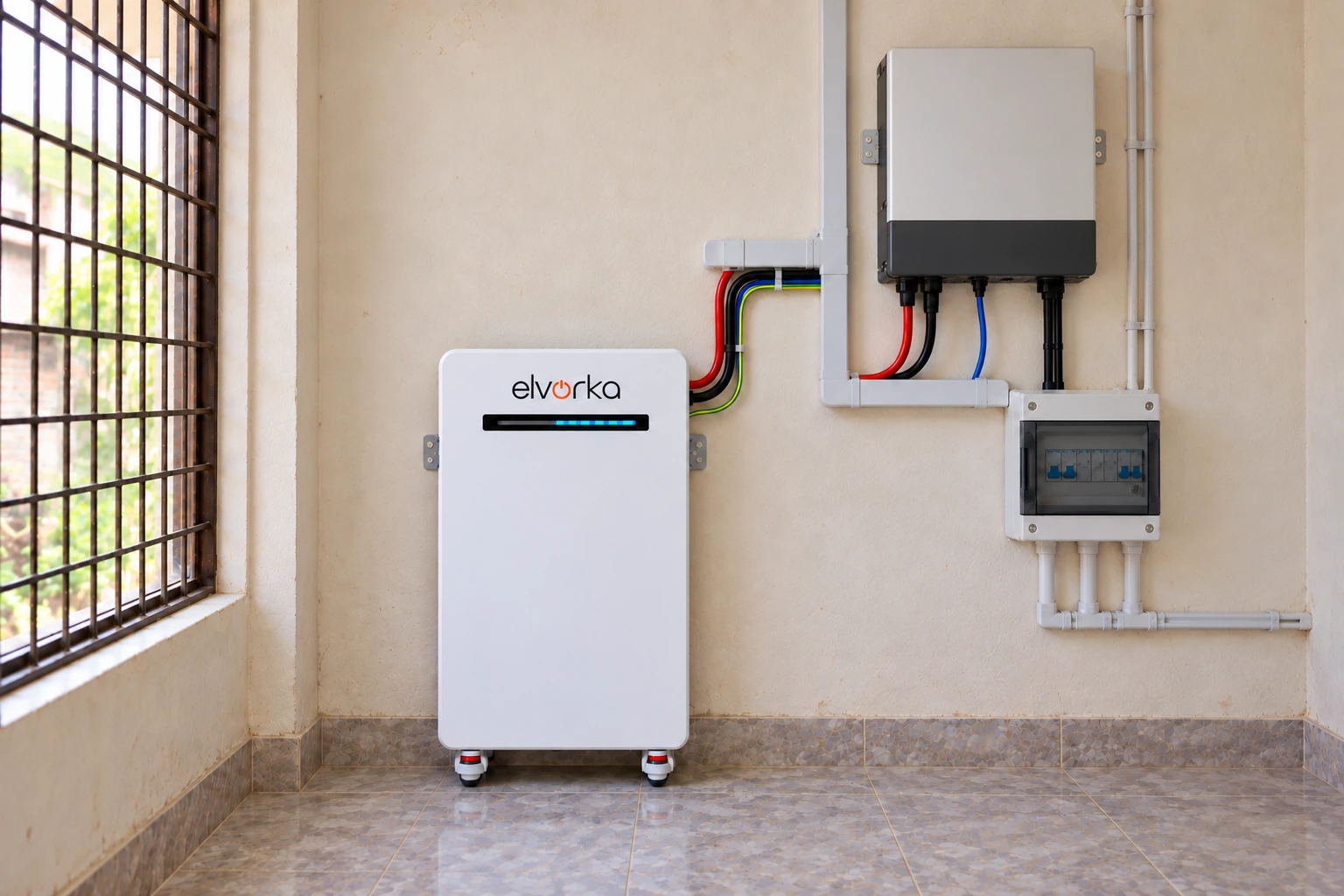
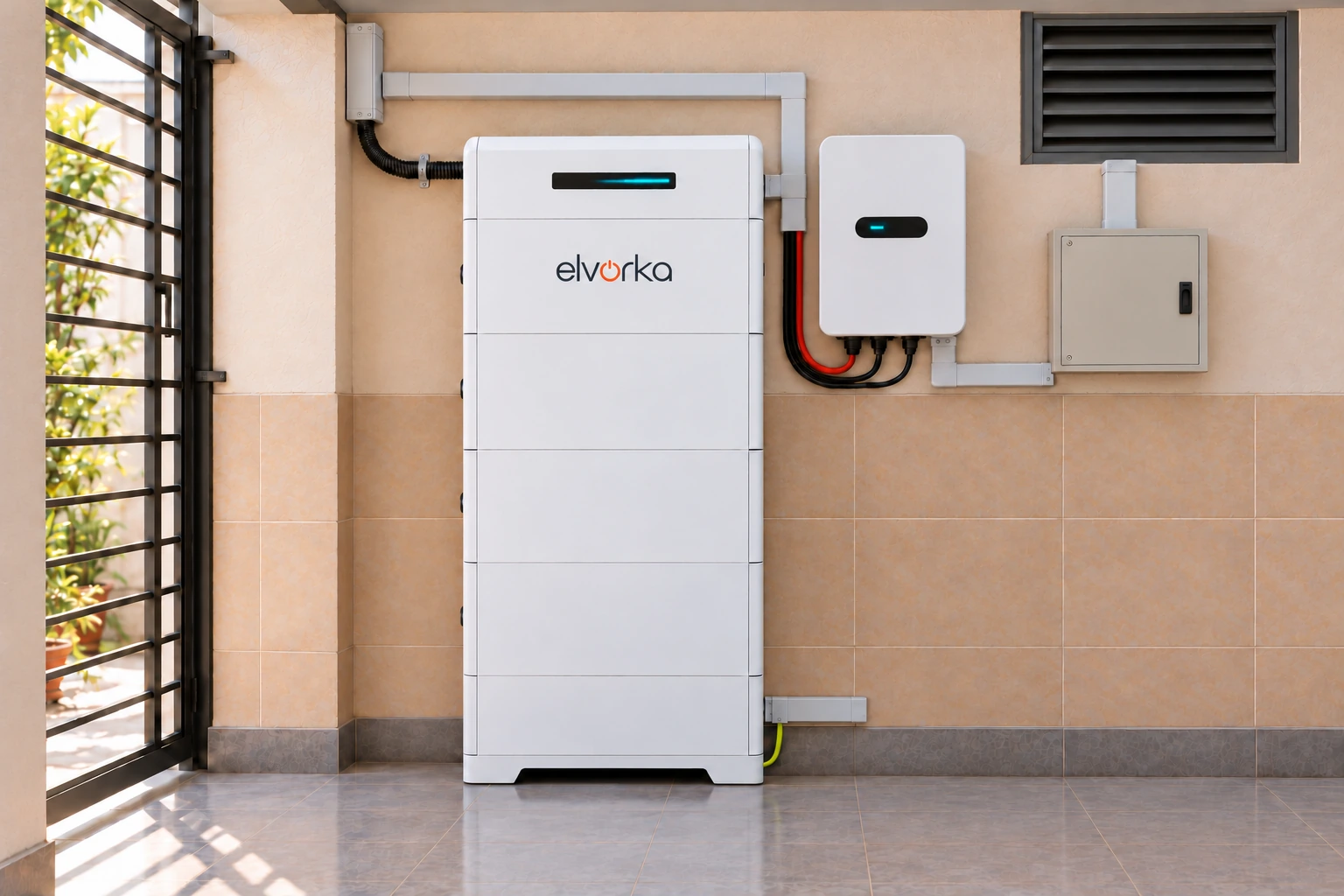
A dry utility room, a seasonally hot garage and a coastal service area place different demands on equipment. Assess conditions where the battery will stand, including the coldest and hottest periods. The following local profiles help frame the questions; they do not certify a particular installation.
Pakistan’s plains, coast and northern uplands have different climate conditions. Keep selected household essentials in the plan, then match the battery format and protected equipment space to the room’s actual heat, moisture exposure and winter temperature.
From a city utility room to a cooler service space, plan for your home.
Urban lowland home: fans, refrigeration and connectivity
A dry utility room gives a household energy reserve a dedicated place near the selected circuits it supports. In warmer lowland locations, the room’s airflow and heat belong alongside the appliance list in the plan.
EU combines battery and inverter for a new indoor IP21 installation. Where a suitable inverter already exists, TR Pro offers compact 51.2 V storage; select energy capacity around the desired hours and preserve cooling and service access.
Questions for your installer
- Which lights, fans, refrigeration and network devices should be supported?
- What is the highest expected temperature inside the equipment room?
Coastal home: protected storage and accessible connections
A sheltered service room can organise storage for a coastal household’s selected essential circuits. Describe actual coastal air, water and condensation exposure so the equipment location becomes part of the design.
Compare a compact TR Pro battery with modular HP Ultra storage, both listed with IP66 enclosures. Choose the electrical architecture for the compatible inverter and the housing for the proposed protected position.
Questions for your installer
- Can coastal air, rain, wash water or condensation reach the proposed location?
- Is the existing inverter a 51.2 V or high-voltage battery system?
Cooler equipment space: a reserve with a seasonal plan
Northern uplands are cooler than the lowlands, and an unheated equipment room needs its own minimum-temperature assessment. A dedicated dry space keeps the installation accessible while the charging plan follows the actual room.
Choose integrated storage for a new complete system or battery-only storage for a compatible inverter. Several supplied families list charging from 0 °C; discuss any explicitly supported TR heating option for the exact configuration when a colder room is involved.
Questions for your installer
- What are the lowest and highest expected room temperatures?
- What charging protection and confirmed heating options apply to the selected model?
Planning notes
- Use kWh to plan energy for the desired duration and kW to check which selected circuits can run together. Confirm inverter AC output, battery current limits and motor/compressor starting requirements for the final system.
- TR Pro lists charging at 0 to 55 °C and discharging at −20 to 60 °C; EU lists charging at 0 to 55 °C and discharging at −20 to 55 °C. HP Ultra’s temperature range needs selected-configuration confirmation. A temperature range is not a full-output derating curve.
- Choose the exact housing with the installation space. TR Pro/HP Ultra list IP66, EU IP21 and TB rack IP20; TR standard and HP K list IP20 with IP54 optional. Shelter, water exposure, condensation and coastal corrosion still need project-specific assessment.
Keep charging and discharging limits separate
The TR Pro literature lists charging at 0–55 °C and discharging at −20–60 °C. The colder discharge boundary is not permission to charge below zero. Self-heating is optional and must be confirmed for the exact configuration. HP Ultra temperature limits require configuration confirmation; do not transfer another family's limits to it.
Read the views, then request the exact manual
The technical library retains the original product views and numbered interface labels. A visible connector is not enough to infer a pinout, polarity or power rating. Confirm the selected model's wiring diagram, protection, cable requirements, clearances, torque values and communication settings from its installation documentation. The scene illustrations are visual references, not wiring instructions.
Record the proposed room, expected temperatures, moisture exposure and maintenance access. For an integrated system, confirm the required AC configuration. For a battery-only system, include the existing inverter model and DC voltage range in the brief.
Questions for your installer
Can these batteries deliver full output in any hot equipment room?
Do not infer that from an operating-temperature range. Use the selected model’s charging/discharging limits, cooling and service clearances, and any available derating information. Assess the hottest expected temperature inside the room, not only outdoor weather.
Does a negative discharge limit allow below-zero charging?
No. Charging and discharging limits are different. Several supplied families list charging from 0 °C, while a negative value applies to discharge. Optional self-heating is configuration-specific and requires confirmation; HP Ultra’s temperature limits also need confirmation for the exact version.
Do these planning examples assume a current outage schedule?
No. Choose the backup hours you want to plan for and supply your actual appliance loads. Final runtime depends on usable battery energy, inverter consumption, changing loads, temperature and operating settings; this page does not state current outage frequency or schedules.